
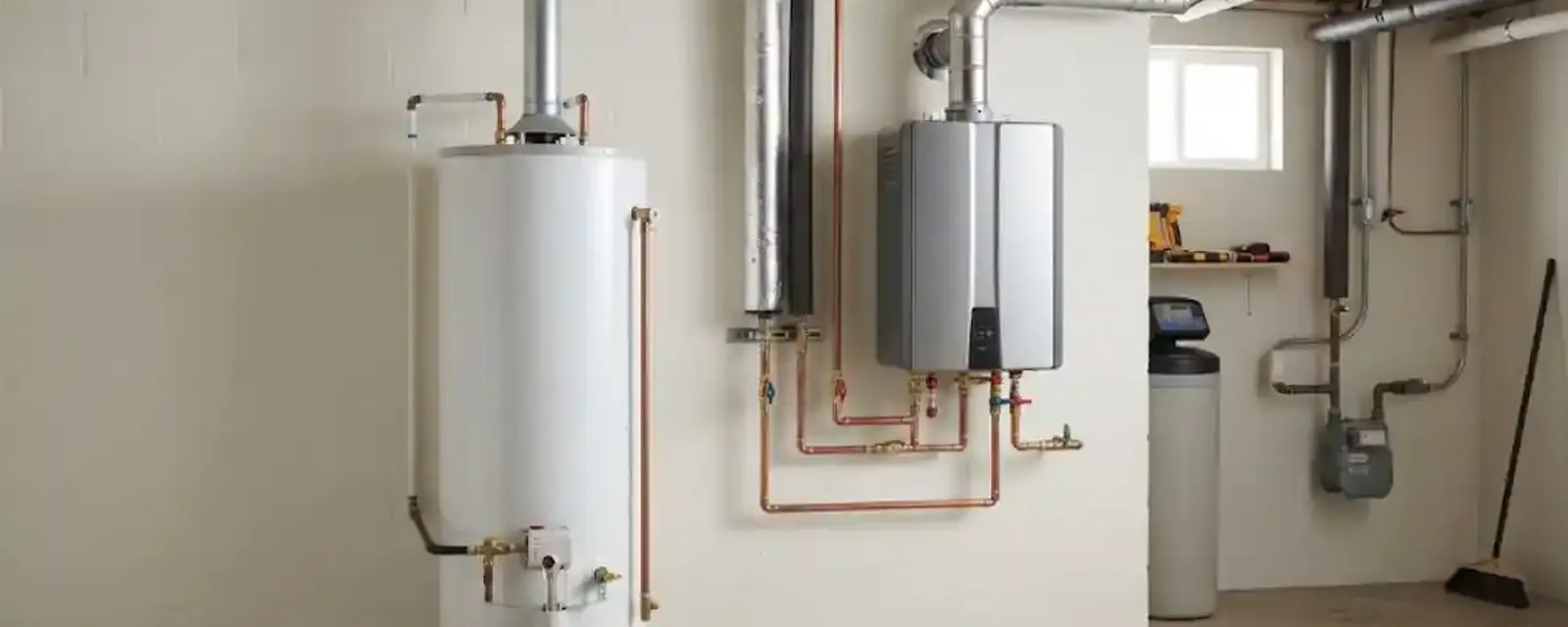
What changes when you remove the tank
A tank stores 40 to 50 gallons of hot water and reheats it when it cools. A tankless unit stores none and heats water as it flows. That makes two changes immediate. The unit needs much more heating power for a moment, and it needs a way to exhaust its combustion gases or, for electric models, a heavy electrical supply.
Because the unit is smaller and wall-mounted, you also gain floor space. The old tank's footprint, the pan and the old venting may all be removed, and walls may need patching where the old flue ran.
The gas line is the first thing we check
A gas tank water heater may draw around 40,000 BTU per hour. A whole-house tankless unit can draw 150,000 to 199,000. The existing gas line, sized for the tank and the furnace, may not carry that. We measure the line length and diameter, add up everything on it and compare the total with the unit's demand.
If the line is too small, it must be upsized, and that is the largest hidden cost of a tankless swap. Ask any installer how they checked, and be suspicious of a quote that does not mention it.
Venting and drainage
High-efficiency tankless units use plastic vent pipe, often run out a sidewall instead of up the old flue. The vent needs the right slope, clearance from windows and a termination spot that suits the house. These units also produce condensate, slightly acidic water that must drain to a floor drain or a neutralizer.
Electric tankless models skip the vent but need a heavy electrical supply that many panels cannot spare. Check capacity before you commit to electric.
Comparison: tank versus tankless
| Factor | Tank | Tankless |
|---|---|---|
| Upfront cost | Lower | Higher |
| Hot water supply | Limited by tank size | Continuous, limited by flow rate |
| Floor space | Takes a footprint | Wall-mounted |
| Typical lifespan | Roughly 8 to 12 years | Often 20 years with care |
| Maintenance | Flush, anode rod | Descale, filter cleaning |
| Install complexity | Simple swap | Gas, vent, drain changes |
When the swap pays off
Tankless savings come from avoiding standby heat loss, which matters most in a home that uses little hot water. The savings can be modest, so the case for tankless often rests on space, a longer service life and never running out for a single long use. If the old tank has just failed and you need hot water quickly, water heater replacement with another tank is faster and cheaper, and you can plan a tankless move later.
What a realistic project timeline looks like
Plan for the day of installation and a little work before it. Before the day, the installer measures the gas line, confirms the venting route and orders any parts, such as a larger gas pipe or a condensate neutralizer. On the day, the old tank is drained and removed, the new unit is mounted on the wall, and the gas, water, vent and drain connections are made.
After the unit is running, the installer should walk you through the controls, the temperature setting and the service valves, and show you where the filter sits. Ask for the manual and the model and serial numbers, since you need them for warranty claims.
Expect to be without hot water for most of a day. If your household cannot manage that, plan the work for a day with fewer demands, and ask whether the installer can finish earlier if the venting is simple.
Mistakes that shorten a tankless unit's life
The most common problem is a unit that was never flushed. Scale builds in the heat exchanger, flow drops and the unit works harder until a sensor trips. The second is poor venting, where condensate pools in a low spot or the vent slope is wrong. The third is a gas supply that was never upsized, so the unit starves at high demand and shuts off.
Each of these is avoidable at installation, which is why the survey and the gas line check matter more than the brand on the box.
Standards behind the swap
Gas tankless water heaters are covered by ANSI Z21.10.3, and the manual lists vent type, gas supply and clearances. Follow those guidelines, and ask the Leawood building department whether the swap needs a permit.
Local note: hard water and the gallons-per-grain conversion
WaterOne, which supplies Leawood, explains on its FAQ that you divide hardness in ppm by 17.1 to get grains per gallon. Using the 120 to 140 mg/L goal it published in an older document, that works out to roughly 7 to 8 grains per gallon. That is enough to scale a tankless heat exchanger over a few years, and WaterOne notes that softeners are a personal choice with a corrosion tradeoff. Check its current report for today's figure.
For the plumbing side, a descaling flush once a year keeps flow strong. Ask about service valves on the unit so a flush takes minutes. If you are in Prairie Village or Mission Hills, the same utility and water apply.
Questions about tankless replacement in Leawood
Sometimes. We compare the line's size and length with the unit's gas demand. If it falls short, the line must be upsized.
Many high-efficiency units vent through a sidewall in plastic pipe. Your layout decides the route.
A tankless installation takes longer than a tank swap, often most of a day, because of the gas, vent and drain work.
Not for a single long use, but they can reach their flow limit when several fixtures run at once.
No. Regular descaling reduces scale, and a softener is a separate choice to weigh against WaterOne's note about corrosion.